Sunday, April 2, 2017

Flipped Learning

Flipped learning allows the students to do some exploring on their own. In a flipped activity, the students do some work outside of the classroom to prepare for the lessons they will do in class. My flipped activity will give them a introduction to government through the famous School House Rock songs and videos. These songs are timeless and have provided students with fun and easy way to remember the most important information about our government. Once in class, they will take what they have learned from School House Rock and expand on that through vocabulary notes, followed closely by an activity that will inform them about major laws and important people who currently work or have worked in the United States' government.


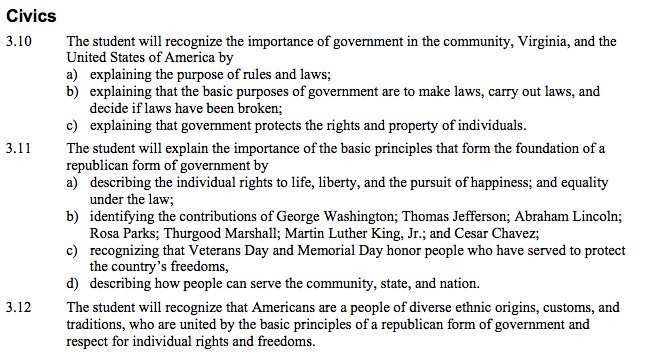
Virginia Standard of Learning: Civics 3.10

Pre-assessment: Students will take a "quiz." I will stress that this not for a grade but that I just want to see how much they know. They will answer the questions below in class before we begin the lessons for this SOL.

Post-assessment: Students will be given the same quiz. This time, it will be for a grade with the expectation that they will receive higher scores. Once students have taken this quiz and mastered the material, we will move on to the material in Civics SOL 3.11 and 3.12 (outlined above). They will then take a final unit exam over all three portions of the Civics SOL, including questions similar to the ones on this post-assessment quiz.

Outside-of-Class Activity:. Students will watch the following School House Rock videos and answer the questions on the worksheet provided for homework. This assignment includes both comprehension questions and critical thinking questions. (If students do not have access to the internet at home, they can speak with me to work out an arrangement for the assignment.) 


In-Class Activity: Students will share what they learned during their outside-of-class activity and then receive important notes about the basic topics (see the fill-in-black notes page for their interactive notebook below). Then, students will be put into groups of 2 or 3. Each group will be assigned a different person to research who worked in government. Some of the people assigned could include: President Barack Obama, President Ronald Reagan, Justice Sandra Day O'Connor, Senator John McCain, Senator (and Secretary of State) Hillary Clinton, and Justice Thurgood Marshall. (Current government officials will be selected only if they have held their office for more than four years.) Using a list of pre-approved websites with information about these important people and our classroom tool for evaluating online sources, students will research their person and answer the questions on the worksheet below about that person's role in the government and important laws they created. They will then share what they have learned with their classmates.


Sunday, March 19, 2017

Evaluating Websites

Teaching students how to verify if a source is credible or not is a vital skill. This can be difficult for younger children in the elementary grades, but it must be learned before they advance to upper grades. It will help them become informed and global citizens of the world. Here is a worksheet that can be given to elementary students. Have them pick a topic they are interested in and ask them to find an article about it after discussing search methods with them. Once they find their article, instruct them to answer these questions and decide if the source they chose would actually be helpful in their research. Download the PDF here!


SmartBoard Review Games


Download Smart Board Activity here! 

For Virginia SOL: Civics 3.10-3.12

This activity is a series of review games that students can do to review some information learned in this SOL. It will review what the important people look, ask them questions about the accomplishments of famous Americans, and quiz them on the important words in the Declaration of Independence. These three games are a great way to review before their exams so the information is fresh in their minds.

I plan to use these three activities as part of a rotation. Students will be divided into small groups during their Social Studies time and they will rotate to different stations throughout the room. One of these stations will be the Smart Board activities found in the link above. Other stations will include review games and assignments that will have them thinking critically about why this is important for them to know and how the impact of these Americans changed our country and our world forever. These activities will make learning fun and engaging. It will also require that students work with those who are in their small groups for the rotation.

All images used in this activity were found on WikiMedia Commons.

Sunday, February 26, 2017

Interactive Digital Story: Martin Luther King Jr., Rosa Parks, and Civil Rights

Interactive Digital Story: Made in iMovie


Student Interactive Assignment: Pick one photo from this video, and write one page about how this makes you feel. Answer these questions in your writing: Have we come a long way since the 1960s? What would Martin Luther King Jr. think of America now? What do you think still needs to change for everyone to be truly equal in our country?


Goal of the Teacher: The goal of this video and activity is to introduce third grade students to the civil rights movement and to Dr. Martin Luther King Jr. and Rosa Parks. This will prepare students for learning more about the important African Americans who helped changed this nation. It will help fulfill the Virginia Standards of Learning: Civics 3.11 and 3.12. This video and follow-up assignment will help them to visualize the movement through pictures and think critically about our nation's history and current events. The medium will help stimulate students, and the photographs will help them see the real-world effects it had on our nation.


Script:


Storyboard:


Photos Used: All photos found and used are copyright free and available for use under Creative Commons.


Information Resources:


About Dr. King. (2014). Retrieved February 21, 2017, from The King Center, 
          http://www.thekingcenter.org/about-dr-king

Martin Luther King, Jr. (2014, May 7). Retrieved February 21, 2017, from National Geographic 
         Kids, http://kids.nationalgeographic.com/explore/history/martin-luther-king-jr/
Rosa Parks and the Montgomery bus boycott [ushistory.org]. (2008). Retrieved February 21, 2017, 
         from U.S. History, http://www.ushistory.org/us/54b.asp

Ruby Bridges. (2014, July 08). Retrieved February 26, 2017, from Biography.com, 
         http://www.biography.com/people/ruby-bridges-475426

Saturday, February 11, 2017

Concept Map: Universal Design for Learning

The Universal Design for Learning allows the teacher to "meet the challenges and take advantage of the opportunities inherent in the great variability of students, offering paths for those currently disenfranchised and developing the talents of all" (Meyer, Rose, and Gordon). As a teacher, it is important to give students options so that they can best choose how to learn the content presented to them. The UDL helps teachers implement the variety into the classroom. Below is a concept map with important features of the UDL that I learned from reading Chapter 4 of Universal Design for Learning Theory and Practice by Anne Meyer, David H. Rose, and David Gordon. The information presented in the concept map will give teachers the steps and tools needed to develop universal designs for learning for the students that need it the most.


Chosen Standard of Learning for ePortfolio

Manipulated Image for Famous American: Martin Luther King Jr.

Learning about famous Americans is a Standard of Learning in Virginia for 3rd grade. One of these famous Americans is Martin Luther King Jr., who famously gave his "I Have a Dream" speech on the steps of the Lincoln Memorial in Washington D.C. Because of my school's proximity to Washington D.C., it is very likely that many students have stood on the famous steps where this speech was given in August of 1963. Below is a manipulated image of the view from the Lincoln Memorial. In the background is a photo I took on a gorgeous late summer/early fall day in early September of 2016. On top of that is an image of the crowd who gathered to listen to Martin Luther King Jr. during the March on Washington for Jobs and Freedom. This manipulated image will take a familiar view for many students in this area and put it in historical context for this SOL. The lack of a crowd in the picture from 2016 will give students an idea of how large the space is while the long view of the crowd will help students understand just how important this day was in history.